Eames Catalog
House of Science
The House of Science, a fourteen minute film by Charles and Ray Eames, made for the United States exhibit at the 1962 Seattle World's Fair.
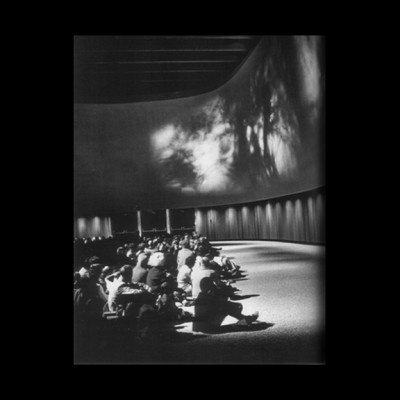
From the magazine SATURDAY REVIEW (May 26, 1962) article by Katherine Kuh about the exhibition: "All the art at the Seattle World's Fair is not in the vast Fine Arts Pavilion. Some distance away at the U.S. Science Exhibit, a remarkable fourteen minute film, produced by Charles and Ray Eames, qualifies as creative art at a high level. In a specially designed oval room the visitor watches multiple images, cast from seven 35-millimeter motion picture projectors, unfold a dramatic prologue to the Science Exhibit (a project for which our government should be roundly applauded). The pictures, thrown on a large concave wall six images at a time, spotlight the complex and comprehensive world of science. Eames has actually invented a new cinematic technique expressly designed to combine the many separate visual experiences at once. Varying his rhythm, perspective, and emphasis with lightning speed, he synchronizes six adjacent moving scenes into a powerful composite statement about science and exhibition."
The United States Science Exhibit began with the Eames's 10-minute short film The House of Science, followed by an exhibit on the development of science, ranging from mathematics and astronomy to atomic science and genetics. The Spacearium held up to 750 people at a time for a simulated voyage first through the Solar System and then through the Milky Way Galaxy and beyond. Further exhibits presented the scientific method and the "horizons of science." This last looked at "Science and the individual," "Control of man's physical surroundings," "Science and the problem of world population," and "Man's concept of his place in an increasingly technological world."
The Century 21 Exposition (also known as the Seattle World's Fair) was a World's Fair held April 21, 1962, to October 21, 1962 in Seattle, Washington. Nearly 10 million people attended the fair. Unlike some other World's Fairs of its era, Century 21 made a profit.
As planned, the exposition left behind a fairground and numerous public buildings and public works; some credit it with revitalizing Seattle's economic and cultural life (see History of Seattle since 1940). The fair saw the construction of the Space Needle and Alweg monorail, as well as several sports venues and performing arts buildings (most of which have since been replaced or heavily remodeled). The site, slightly expanded since the fair, is now called Seattle Center; the United States Science Pavilion is now the Pacific Science Center. Another notable Seattle Center building, the Experience Music Project, was built nearly 40 years later and deliberately designed to fit in with the fairground atmosphere.
The World of Science centered on the United States Science Exhibit. It also included a NASA Exhibit that included models and mockups of various satellites, as well as the Project Mercury capsule that had carried Alan Shepard into space. These exhibits were the federal government's major contribution to the fair.
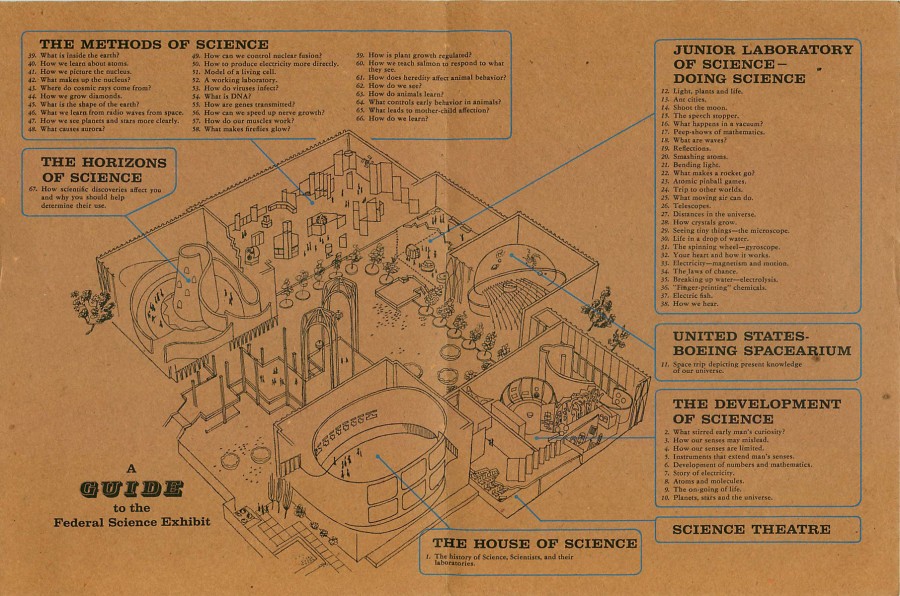
In ADDITIONAL NOTES below you can see a schematic of the U.S. Science Exhibit. The Eames film was shown in the specially designed oval-shaped theatre which is marked, "HOUSE OF SCIENCE."

ADDITIONAL NOTES AND IMAGES
We add new Catalog entries every week. Please check back often,
or sign up with your email and we'll keep you posted on our progress.